



Description
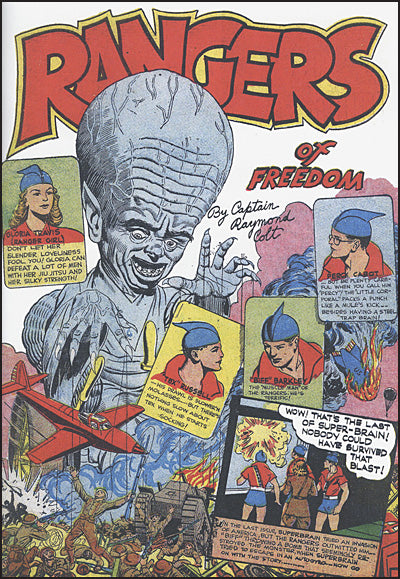
Rangers was one of Fiction House's long-running titles, alongside Fight and Jumbo and Planet. But the first seven issues were actually titled Rangers of Freedom and the lead-off feature was this Boy Commandos-style group: "Biff" Barkley, "Tex" Russell and Peter Cabot, three young men who were recruited by the FBI, plus Ranger Girl. They donned patriotically themed bulletproof costumes and fought Nazis. The rest of each 64-page issue featured back-up strips like "The Royal Watch," Defense Patrol, Anzac Hawks by Bob Jenny, Rocky Hall Jungle Stalker, Sea Squad, and Don Stuart of the Far East Rangers. Fiction House was not one for superheroes, and our Ranger of Freedom had no secret identities. But in their bullet-proof outfits, together with Ranger Girl, they fought villainous Nazis and Japanese forces led by the Super-Brain and the Black Dragon Society. If anything, they were influenced by the world-dominating menaces found in the pulps. After all, Fiction House was also a pulp publisher. This young group actually pre-dates Simon & Kirby's Boy Commandos, who are today much better known. Kid groups like this were found also in Star Spangled (The Newsboy Legion, also by S&K), Daredevil Comics, Boy Comics... But our Rangers here had the advantage of special outfits and costumes rarely seen in other kid groups, with the possible exception of the super-hero sidekicks in Timely's Young Allies. Issue #3 has a bondage/torture cover. Additional artists include Dan Zolnerowich (covers), Joe Doolin (a top-notch and prolifc cover artist for Fiction House), Al Walker (who deserves an entire book of his own; Michael Gilbert did a multi-part series on this genius), Harry Fisk and Richard Case. Three massive 64-page issues were all published in 1941, just before the U.S. entered World War II. The title reverted to just Rangers with issue #8 as the U.S. jumped into the war. Later covers featured American doughboys and lovely ladies in peril, nurses, island girls, even flyers, with an abundance of bondage and good-girl art. With #40, the half-Native American beauty Firehair took over the cover and ran with it with western-themed lead stories, until the final issue with #57 in 1951. The hardcover and softcover editions have different covers.
Product Details
Cover: Hardcover
Page Count: 184
Dimensions: 7.0 (w) x 10.0 (h) x 0.0 (d)